Blog

Fall Safety Review: Cadillac Wipers, Lights, and Brakes | Cadillac of Jackson

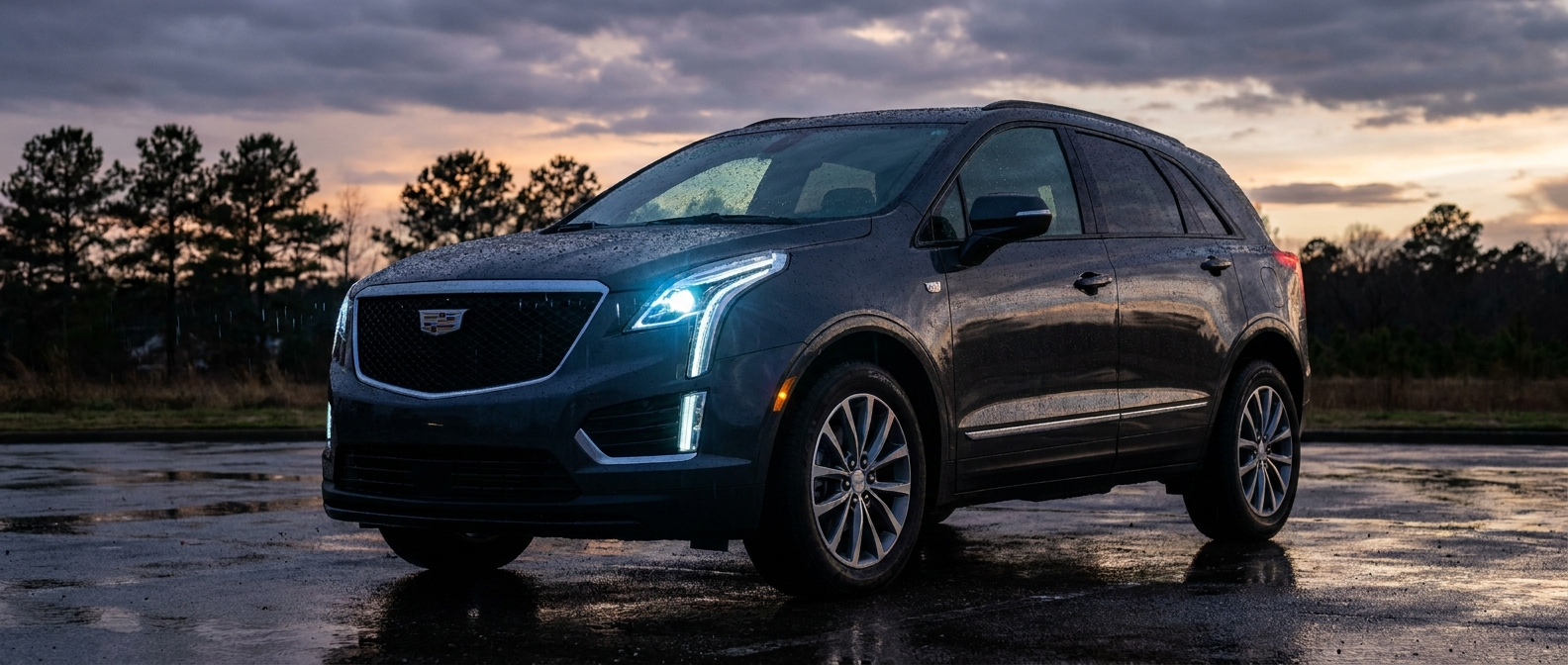
2026 Cadillac XT5 with LED headlights on during a wet fall evening in Ridgeland, Mississippi

October in the Jackson metro is a transition month, and it doesn't announce itself politely. The afternoon storms of early October can drop an inch of rain in under an hour on I-55, and by the last week of the month you're running headlights on your morning commute through Ridgeland with visibility cut by fog rolling in from the low ground along the Natchez Trace corridor. Three systems carry the load when conditions shift like that. Your wipers, your lights, and your brakes. We'll show you how to know they're ready, and exactly what our team checks when your Cadillac comes through our service bay.

The 2026 Cadillac XT5 is the vehicle we see most often on this particular inspection, so we'll use it as the baseline and note where the Escalade diverges.

Where Does Your Fall Inspection Begin?

You can answer two of the three questions from your own driveway before you ever schedule service, and knowing that is useful because it tells you whether the issue is obvious or whether it needs a trained eye on a lift. Stand in front of the vehicle at night and watch whether the headlights illuminate fully and evenly. Run the wipers through a full cycle with the washer fluid. Listen when you brake at low speed with the windows down. What all of that tells you is whether the problem is plain or whether it needs a closer look, and a closer look is what we're set up to do. None of it requires a lift.

The table below gives you the model-specific wiper blade sizes for our lineup, the headlight type, and the brake pad alert mechanism on each. These details matter because ordering the wrong blade size is an easy mistake, and understanding how your car tells you the pads are low changes whether you get caught off guard.

Cadillac ModelDriver WiperPassenger WiperRear WiperHeadlight TypeBrake Alert System
2026 XT524 in20 in12 inLED, auto on/off + IntelliBeam auto high beamElectronic Brake Pad Life Monitor
2026 Escalade / Escalade ESV22 in22 in12 inOEM LED AdaptiveElectronic Brake Pad Life Monitor
2026 LYRIQ / OPTIQ / VISTIQVerify at serviceVerify at serviceVariesFull LEDElectronic Brake Pad Life Monitor

One thing worth noting about the XT5 is that the driver and passenger blades are different lengths (24 inches and 20 inches, respectively). It's an asymmetric pair. Owners who replace them independently sometimes install a matched set of 22-inch blades, then wonder why the driver side streaks at highway speed. Ask our team to confirm the correct pair at your next service visit.

Schedule a Fall Safety Inspection

The Maneuvering Play: Lights and Brakes When Conditions Change

The 2026 Escalade's OEM LED adaptive headlights and the XT5's IntelliBeam auto high-beam system are genuinely capable technology, and how they behave after dark matters more in fall than in summer. IntelliBeam, standard on the 2026 XT5, switches on its own between high and low beam based on oncoming traffic and vehicle speed. Streetlighting on Highway 51 north of Ridgeland thins out after dark. That stretch is exactly where the system earns its keep.

The tradeoff is worth knowing. The adaptive and auto-high-beam systems depend on a clean, unobstructed lens. In Mississippi, the summer's UV exposure and the early fall's bug traffic both leave residue on headlight covers that a routine wash doesn't fully address. Our team includes a lens condition check in every fall inspection, because a fogged or pitted lens scatters light instead of projecting it, and that scattering is invisible to the driver sitting inside the car.

On brakes specifically, the line we hear from owners is that it doesn't squeal, so it must be fine. That logic holds for mechanical wear indicators. But the 2026 XT5 and Escalade both use an electronic Brake Pad Life Monitor. Thickness sensors embedded in the front and rear pads calculate remaining pad life and report it as a percentage through the Driver Information Center. The alert appears in the DIC before the pads reach the 2mm discard threshold, which is also roughly where the mechanical squealer would engage. So on these vehicles, you're supposed to act before the squeal. If you've dismissed the DIC alert once or twice waiting to hear a sound, that's the moment to schedule service.

The Cadillac LYRIQ and the VISTIQ carry the same Brake Pad Life Monitor architecture. On the electric models, regenerative braking reduces the rate at which friction pads wear compared to a conventional drivetrain, which is useful for longevity, but it also means the pad wear pattern can be less predictable without the monitor.

Cadillac's own service guidance calls for a brake system inspection every 7,500 miles, timed to coincide with tire rotation. I-55 runs between Madison and the Beltway. For north-metro drivers who log substantial highway miles on that route, the interval arrives faster than it seems.

Parking tip: When you bring your vehicle in for a fall inspection and we also handle a tire rotation, we get eyes on the rotors and calipers while the wheels are off. No moment is more efficient for confirming brake condition than a rotation, and fall is an ideal time to build both into one visit before the holiday travel season.
On wiper etiquette: Mississippi's afternoon storm cells in October are brief and intense rather than prolonged. Your wipers may run at full speed for ten minutes and then sit unused for days. Rubber that sits through heat cycles without use develops a slight set, a memory of the position it rested in, and that can cause an initial streak when the next storm hits. If your wipers chatter on the first pass after a dry spell, that's the pattern to watch. NHTSA notes that wiper blades should be inspected seasonally and replaced when streaking or chattering persists.
Next step: If your Driver Information Center shows a brake pad life percentage below 30%, or if your wipers streaked through the last rainstorm, don't let it carry into the holiday season. A single service visit covers all three systems.

A Go-Ready Checklist Before the Back Half of Fall

Run through this checklist before the back half of fall arrives, and you'll handle the two-thirds you can judge from your own driveway while flagging the third that genuinely needs a lift, since the items below are sequenced so the quick visual checks come first and the shop work comes last. The visual checks take under ten minutes. You'll know exactly which ones to hand off to our team.

  • Wipers (visual, 2 min): Run the wipers on a wet windshield. A clean sweep with no streak or chatter means the blade edge is intact. Any persistent smear across the glass means the rubber has hardened or torn. For the 2026 XT5, that means replacing the 24-inch driver blade and the 20-inch passenger blade as a matched pair.
  • Washer fluid (30 sec): Trigger the washers and confirm the nozzles are clear. A blocked nozzle deposits fluid to one side of the glass and leaves the other half dry.
  • Headlights (visual, 3 min): Park facing a flat surface at night and note whether both beams illuminate to the same height and spread. A noticeably dimmer or lower beam on one side points to a lens or bulb condition worth having checked.
  • Lens clarity (visual, 1 min): In daylight, look straight at the headlight covers. Any yellowing, hazing, or surface pitting is worth flagging at your next appointment.
  • Brake Pad Life Monitor (10 sec): Check your Driver Information Center for the brake pad life percentage. Cadillac's guidance calls for inspection at every 7,500-mile interval. A reading below 30% is the signal to schedule service before you need it urgently.
  • Brake feel (on the road, 5 min): At slow speed with the windows down, apply steady brake pressure and listen. Grinding or a high-pitched squeal means the friction material is at or below the 2mm threshold and our team needs to see it promptly.
  • Brake fluid (at your appointment): Brake fluid absorbs moisture over time, which lowers its boiling point. Our technicians measure fluid condition during the inspection. This one isn't a driveway check.
  • Rotor condition (at your appointment): Scored, grooved, or visibly lipped rotors show up when the wheel is off. We inspect rotor surface and measure thickness against the minimum specification stamped on the hub during every brake service.

Book your fall service appointment online.

Cadillac of Jackson

700 Adcock St, Ridgeland, MS 39157

(601) 948-5183


Recommended Posts

2026 Cadillac Escalade on the Natchez Trace Parkway in Mississippi during autumn travel

Cadillac Battery Testing Before Cooler-Weather Travel | Ridgeland

In this article What's Actually Going On With Your Battery? The Mississippi Heat Mechanism: Why Summer Builds the Problem The EV Lineup Has Its Own 12V Battery Story DIY Checks vs. What the Service Team Does A certain symptom turns up around this time every year. The vehicle ran fine through September and October. Then a cold front drops overnight lows into the mid-30s, and the morning hands you either a sluggish crank, a cluster of warning lights you've never seen, or, in an EV, a "Reducing Features" alert that wasn't there a week ago. The cause is almost never the temperature itself. Cold is just the moment of reckoning. What actually happened was July. A Jackson metro summer runs three solid months of afternoons above 90 degrees F, with humidity that holds heat under the hood long after sundown. That sustained thermal stress speeds up plate corrosion and electrolyte degradation inside an AGM battery, quietly trimming its capacity. The battery keeps starting the car through the warm months because warm months ask less of it. Then November arrives, the electrochemical reactions slow, and a battery sitting at 70% of its original capacity turns out to have needed more. Our service team at Cadillac of Jackson can run a full battery load test before that moment finds you, and before Thanksgiving travel or a business run to Nashville puts a marginal battery under real stress. What's Actually Going On With Your Battery? Symptom Likely Cause What to Do Sluggish or slow crank, especially on the first cold morning AGM battery below serviceable CCA threshold; cold reduced available current Load test immediately; a single cold-failure event often precedes rapid decline Random warning lights (traction control, parking assist, infotainment resets) Voltage sag during starting drops below 9.6V, triggering module brownouts Load test and charging-system check; ghost codes that clear themselves are a battery signal "Reducing Features" or "Propulsion Power Reduced" on LYRIQ, ESCALADE IQ, OPTIQ, VISTIQ 12V auxiliary battery low or parasitic draw keeping it from topping off Have the 12V checked separately from the high-voltage pack; it's a different system Battery that tested fine last spring now struggling Summer heat accelerated internal degradation between tests Test again now; heat damage accumulates silently and shows up in cold Visible corrosion on terminals, or battery case that looks swollen Advanced deterioration; heat buckled the case or vented the electrolyte Replace promptly; a compromised case is not a borderline call The Mississippi Heat Mechanism: Why Summer Builds the Problem The XT5 and the full ICE lineup carry factory-spec AGM batteries, which handle both heat and cold better than conventional flooded batteries, and that resilience is genuine. That resilience has limits, though, and heat is the AGM's tougher adversary, not cold. Inside any lead-acid AGM battery, current comes from an electrochemical reaction between lead plates and a glass-mat electrolyte. High ambient temperatures push that reaction past its design pace, gradually corroding the plate surfaces and shrinking the battery's usable surface area. By the time the battery is two or three years old, after three Jackson summers, the heat-driven degradation can leave it well below its rated cold cranking amp output, even while it still rests at a reasonable open-circuit voltage. Our service team sees a specific pattern. A battery that reads 12.5 or 12.6 volts at rest looks plausible on a quick check. Only under load, when the starter pulls a surge of current and system voltage has to stay above 9.6 volts, does the hidden capacity loss turn into a failure. A battery testing at 65% of its rated CCA on a 50-degree November morning is marginal. At 35 degrees, it's a problem. Important: A cold battery can produce a falsely low CCA reading in testing. Per GM's published service guidance, an AGM battery should be warmed to above 40 degrees F (4 degrees C) before any load test is conducted. A battery tested in a cold garage may appear to fail when it would actually pass at room temperature. This matters if you're trying to decide whether to replace or not. The EV Lineup Has Its Own 12V Battery Story Every Cadillac EV carries two batteries, and the smaller of the two is where the surprises hide, because the LYRIQ, the ESCALADE IQ, the OPTIQ, and the VISTIQ all run a separate 12-volt AGM auxiliary battery alongside the high-voltage Ultium pack, a system most online guides skip entirely. They're two entirely different systems, and the distinction matters more than it sounds. The high-voltage Ultium battery powers the drive motors and handles range. The 12V auxiliary battery powers the locks, the infotainment system, the instrument cluster, the charging control modules, and the systems that let the vehicle boot up at all. Drop the 12V below threshold and the high-voltage system can't wake. The car won't start. The range on the display doesn't matter. A Cadillac EV has no alternator. The 12V battery is maintained by a DC-to-DC converter that draws from the main high-voltage pack and recharges the 12V at set intervals as the car sits unused. Let the vehicle sit for long stretches without a charge, or let a module keep the system from going fully to sleep, and the 12V can drain. That particular issue (a parasitic draw from an infotainment or gateway module that doesn't fully sleep) has been documented on LYRIQ models and addressed by GM through software updates. For owners, the takeaway is simple. The 12V auxiliary battery in a Cadillac EV deserves its own inspection, and you shouldn't assume the high-voltage pack's health covers everything. Next step: If your Cadillac EV has shown a "Reducing Features" alert, a "Propulsion Power Reduced" message, or unusual warning clusters after a cold night, contact our service team before your next long trip. Those symptoms often resolve once the 12V is addressed, but they don't resolve on their own. Schedule a Pre-Travel Battery Inspection DIY Checks vs. What the Service Team Does You can run a sensible first check at home with a digital multimeter, and it's worth doing, but a multimeter only tells you part of the story, and the part it leaves out, the battery's behavior under real starting load, is exactly the part that strands you on a cold morning. A healthy, fully charged 12V AGM battery at rest reads approximately 12.6 to 12.8 volts. A reading below 12.4 volts at rest, after the vehicle has sat for several hours, suggests the battery isn't holding a full charge and warrants a proper load test. Treat that as an early warning and nothing more. A home multimeter can't measure true cold cranking amp delivery under load, can't assess the alternator's charging output on gas models or the DC-to-DC converter health on EVs, can't detect parasitic draws quietly draining the system, and can't catch a battery that holds voltage at rest but collapses under the starting load. That last scenario, a battery with strong resting voltage and severely reduced CCA output, is exactly the failure pattern that surprises drivers who thought they'd already checked. A professional load test applies a controlled current draw and measures voltage stability at the same time, so it tells you whether the battery can actually sustain the surge the starter demands, charge level aside. Pair that test with an alternator output check on ICE models, or a DC-to-DC converter voltage check on the EV lineup, and you can see the charging system as a whole instead of guessing from one component. Skip the temptation to read a battery's health from its age alone. A battery under four years old that passes a load test confidently probably just needed a full charge cycle. Past five years and testing at 70% of rated CCA or below, replacement before winter travel is the straightforward call. AGM batteries in modern vehicles typically serve four to seven years, and a marginal one at the edge of that range doesn't get better by waiting. Frequently Asked Questions Does cold weather actually damage my Cadillac's battery, or just slow it down temporarily? Cold doesn't damage a healthy AGM battery. What it does is reveal damage that heat already caused. At 32 degrees F, a battery delivers roughly 65% of its rated capacity. At 0 degrees F, that figure drops to around 50%. If the battery's internal structure was already compromised by Mississippi's summer heat, those cold-weather reductions push it past the starting threshold. A battery with strong capacity comes through the first cold front without issue. A marginal one doesn't, and the cold gets the blame for a problem that formed in July and August. Why is my Cadillac showing warning lights and infotainment resets in cooler weather, even though it starts? A weak AGM battery can allow system voltage to sag below 9.6 volts during the cranking surge, which is enough to trigger a brief brownout in the vehicle's electronic modules. Those modules may reboot or log fault codes, producing warning lights on the instrument cluster, infotainment restarts, or error messages from the driver assist systems. The vehicle starts because the battery still has just enough capacity to turn the engine over, but the voltage drop during that effort disturbs the sensitive electronics. Load-testing the battery and checking the charging system will typically identify the cause. These are not random software glitches; they're a battery signal. Book Your Battery Check Cadillac of Jackson 700 Adcock St, Ridgeland, MS 39157 (601) 948-5183

2026 Cadillac VISTIQ parked in Brandon Mississippi suburban driveway at dusk

3 Cadillac SUVs Compared for Brandon-Area Families | Cadillac of Jackson

In this article How Do These Three Cadillac SUVs Actually Compare? Which Model Does the Third Row Change Everything For? Does the VISTIQ's Electric Range Actually Work for Brandon Families? How Do You Match the Right Cadillac to Your Family's Actual Week? Which Cadillac SUV fits our family? The answer isn't the same for every household in Brandon. It depends on two rows versus three, a daily electric commute versus a boat-trailer weekend, and whether the rear seats need to hold adults or just fold flat for Costco runs now and then. We work through all three models on our lot, and the thing that separates them is rarely brand or prestige. It comes down to size, configuration, and whether the family charges at home. Below is how the 2026 Cadillac XT5, the 2026 Cadillac VISTIQ, and the Escalade family actually compare when you measure them against what Brandon households need. The short version XT5: The choice for established couples or small families who want two refined rows, 63 cubic feet of cargo flat, and a cabin that makes the I-20 run to Ridgeland feel like nothing. VISTIQ: The choice for a family that needs a genuine, adult-usable third row, wants to do most of its driving on a single charge, and is ready to plug in at home each night. Escalade / Escalade ESV: The choice when the third row gets used every trip, a trailer is in the picture, or the household simply needs the most presence and interior space Cadillac builds. The tradeoff: The XT5 gives up the third row. The VISTIQ's cargo behind that third row is tight. The Escalade ESV solves both but asks for more garage. How Do These Three Cadillac SUVs Actually Compare? These three sort cleanly by size and powertrain, with the XT5 covering five seats, the VISTIQ and Escalade covering seven, and the Escalade ESV adding a tow hook plus roughly fifteen more feet of vehicle, so once you lay the matrix flat the choice gets a lot more practical. The spread is wide. The Escalade ESV stands alone on cargo and towing; the VISTIQ is the only electric three-row in the lineup; and the XT5 is the one you choose when two rows and a quieter footprint are exactly right. Spec 2026 XT5 2026 VISTIQ 2026 Escalade 2026 Escalade ESV Rows / Seating 2 rows / 5 3 rows / 7 3 rows / 7 3 rows / 7-8 Cargo behind 3rd row n/a 15.2 cu ft 25.5 cu ft 41.5 cu ft Cargo behind 2nd row 30 cu ft 43 cu ft 72.9 cu ft 94.1 cu ft Max cargo (all rows flat) 63 cu ft 80.2 cu ft 120.5 cu ft 142.2 cu ft Powertrain 2.0T / 3.6L V6 (gas) Dual-motor EV 6.2L V8 (gas) 6.2L V8 (gas) Power output 235-310 hp 615 hp 420 hp 420 hp Towing capacity Up to 3,500 lbs Towing not recommended for range Up to 8,100 lbs Up to 8,000 lbs EPA estimate 24 mpg combined (FWD 2.0T) 305 miles / 86 MPGe combined Varies by config Varies by config Overall length 189.6 in 205.6 in 211.9 in 226.9 in Best for Couples, small families, commuters Families needing 3 rows + EV range Large families, towers Maximum cargo + adult 3rd row Which Model Does the Third Row Change Everything For? Among Brandon and Rankin County families, the third row is the single spec that reorders this whole lineup, and the XT5 settles its own case immediately by not having one, which stays a deliberate engineering choice that keeps the cabin proportions tight and the driving character intact rather than any kind of flaw. If your household runs two adults and maybe one child in the second row, the XT5's 30 cubic feet behind that seat (and 63 flat) swallows school gear, weekend luggage, and a Costco trip without asking anything of you. The gap opens once a third row becomes genuinely necessary. Cadillac rates the VISTIQ third-row legroom on a 122-inch wheelbase, and independently published road tests confirm adults can ride back there without folding their knees into the seatback. The Escalade does the same for seven, and the Escalade ESV extends that third-row comfort by an additional 1.8 inches of legroom (36.7 inches versus 34.9 in the standard wheelbase, per Cadillac specifications). The XT5 is the right call for five. If a sixth or seventh seat is a real need, not a hypothetical one, the VISTIQ and Escalade are where the conversation starts. For families with three kids in school, or households that routinely move a full complement of adults, the jump from the XT5 to the three-row options reads less like a trim upgrade and more like a different vehicle class entirely. Explore Financing Options Does the VISTIQ's Electric Range Actually Work for Brandon Families? It works for most Brandon families, and the math behind that is specific, since the EPA estimates 305 miles of range for the 2026 VISTIQ on the standard 11.5-kW charger configuration, and Brandon sits roughly 25 miles east of Ridgeland on I-20 and Highway 80, so a round trip to our showroom and back adds about 50 miles to a charge. Add school runs, the occasional trip up to the reservoir, and a typical day of Rankin County driving, and the VISTIQ's daily range clears that routine without ever needing a public charge, reservoir mornings included. The genuine tradeoff for the VISTIQ sits at the cargo wall behind that third row, where you get 15.2 cubic feet with all seven seats occupied. A weekend bag each is about the limit. Pack a hockey tournament's worth of gear with a full load of passengers, and you'll run out of room fast. The VISTIQ's maximum cargo space of 80.2 cubic feet (second and third rows down) is competitive for a midsize SUV, and 43 cubic feet behind the second row is generous. But if the family needs all seven seats in use and substantial cargo at the same time, the Escalade ESV's 41.5 cubic feet behind its third row makes that easier. The VISTIQ pairs dual-motor all-wheel drive with 615 horsepower as standard. Its EPA combined efficiency estimate lands at 86 MPGe. For a household that charges nightly at home, the VISTIQ replaces a fuel stop entirely on most weekdays. VISTIQ Escalade ESV Pros EPA-estimated 305 mi range; 615 hp; EV running costs; 7 seats 41.5 cu ft behind 3rd row; tows up to 8,000 lbs; adult-usable 3rd row; 142.2 cu ft max cargo Cons 15.2 cu ft behind 3rd row (seats up); no meaningful tow capacity Fuel cost of a 6.2L V8; 226.9 inches long; not for households that want EV running costs The Ross Barnett Reservoir makes a natural reference point here. A family heading out on a Saturday morning, boat in tow, needs either the Escalade or the Escalade ESV, and none of that is a knock on the VISTIQ. Physics does the deciding. Trailer loads cut sharply into an EV's range, and the VISTIQ isn't rated for meaningful towing, so if the trailer comes out often, the 6.2-liter V8 in the Escalade (rated to tow up to 8,100 pounds properly equipped, per Cadillac specifications) is the straight answer. How Do You Match the Right Cadillac to Your Family's Actual Week? Matching the right Cadillac to your week starts with a sharper question than seat count, because what settles the decision is which seats you actually fill and how often, and three household profiles sort that out almost automatically once you picture a normal week. Most families recognize themselves inside a sentence or two. The five-passenger household with highway commutes. Both adults commute, the rear seat holds one or two children, and the weekend trip is luggage plus cargo, not a trailer or a full third row. The XT5 fits this household precisely. Its 2.0-liter turbocharged four-cylinder earns an EPA estimate of 22 city / 29 highway / 24 combined (FWD configuration), which matters on the I-20 corridor where daily mileage adds up. At 189.6 inches overall, it also garages cleanly in the standard two-car setups common in Brandon neighborhoods. The seven-seat family that commutes daily and charges at home. This household fills all three rows on a regular basis, has a Level 2 charger in the garage (or plans to install one), and doesn't pull a trailer. The VISTIQ is built for exactly that profile. Its 305-mile EPA estimate clears a full week of Rankin County driving on a single charge cycle with margin to spare. The cabin carries the same technology suite and material standard as the rest of Cadillac's electric lineup. The household that needs everything. Full three-row seating, real cargo behind that third row, towing capacity for a boat or trailer, and enough interior space for a long drive to the Gulf Coast or beyond. The Escalade ESV is the answer. Its 41.5 cubic feet behind the third row (versus 25.5 in the standard Escalade) and 142.2-cubic-foot maximum cargo capacity aren't close to anything else in the lineup. At 226.9 inches, it's a vehicle that asks for a larger garage bay or a driveway with room to spare. Our team's honest observation: When Brandon families come in uncertain between the VISTIQ and the Escalade ESV, the question that resolves it most cleanly is trailer frequency. If a trailer comes out more than a handful of times per year, the Escalade wins on capability without debate. If the trailer's rare and the EV running cost appeals, the VISTIQ earns that household's daily miles in a way a V8 simply can't match. Frequently Asked Questions Does the Cadillac XT5 have a third row? No. The 2026 XT5 is a two-row, five-passenger SUV. Cadillac built it to prioritize second-row comfort and cargo versatility over raw passenger count, giving the rear seat 39.0 inches of legroom and the cargo area 30 cubic feet behind it, expanding to 63 cubic feet with the seats folded. If a third row's a genuine requirement, the VISTIQ and the Escalade family are where you start. How far can the 2026 Cadillac VISTIQ travel on a full charge? The EPA estimates 305 miles of range for the 2026 VISTIQ in standard 11.5-kW charger configuration. That figure covers round-trip Brandon-to-Ridgeland commutes and routine Rankin County driving with meaningful charge remaining. Towing or carrying a maximum load reduces the available range, as it does on any EV, so households that regularly pull a trailer should look at the Escalade's 6.2-liter V8 platform instead. Get a Trade-In Estimate Cadillac of Jackson 700 Adcock St, Ridgeland, MS 39157 (601) 948-5183

2026 Cadillac Escalade at a dealership service drive in Ridgeland, MS before holiday travel season

What to Ask About Cadillac Service Before the Holiday Rush | Ridgeland

Before the Thanksgiving and Christmas travel season stacks up on the I-55 corridor, the right service conversation starts with one question your advisor needs you to answer first. Is your Cadillac a gas model or an electric one? The answer reshapes every item on the checklist. Schedule that conversation now so your Cadillac is ready before the bays fill up. Gas models follow the Oil Life Monitor; electric models run on a completely different set of intervals. Know which category you're in, and the rest of the conversation gets straightforward. What Does My Gas Cadillac Actually Need Right Now? Your gas Cadillac leans on the Oil Life Monitor as its starting point, and that system isn't a simple odometer counter; Cadillac's on-board logic tracks engine temperature, trip length, and driving style to calculate remaining oil life as a percentage, with cadillac.com listing 7,500 miles or 12 months as the standard rhythm for oil and filter service. Ask your advisor this directly. "What does my Oil Life Monitor show, and is it worth combining service with a tire rotation before Thanksgiving?" Pairing both at one visit is efficient, and that 7,500-mile rhythm covers the rotation anyway. If your monitor sits above 40 percent, you may not need oil service yet. If it's closer to 15 percent, you'll want it done before a long run up I-55. Ask specifically. Don't just book because a few months have passed. Gas models in the lineup (the CT5, the XT5, the Escalade) also run on dexos1-certified full synthetic oil. That spec matters for the turbocharger bearings on the XT5's 2.0-liter turbocharged engine in particular. Ask whether dexos1 synthetic is what goes in. A yes is the answer you want. Question to Ask What a Good Answer Sounds Like What is my current Oil Life Monitor percentage? A specific number, not "probably fine" Should I combine oil service with a tire rotation? Yes, if the monitor is below roughly 30-40 percent Does my engine take dexos1 full synthetic oil? Yes, for all current gas Cadillac models Is there anything flagged on the multi-point inspection? A specific list of any noted items, not a blanket clearance What's the earliest appointment before Thanksgiving week? A date, not "we'll call you back" The multi-point inspection is worth asking about on its own. Cadillac Certified Service includes one with every scheduled visit. Ask your advisor to walk you through any flagged items in writing before you approve additional work. What's Different About Electric Cadillac Service, and What Questions Should I Ask? Electric Cadillac service catches owners of the LYRIQ, VISTIQ, OPTIQ, ESCALADE IQ, and ESCALADE IQL off guard, because no engine oil exists, which really does strip one visit's worth of work off the calendar, and yet skipping oil doesn't mean skipping service. The questions that matter just shift. Cadillac's EV maintenance schedule centers on a few specific items. Tire rotations still land every 7,500 miles (electric models carry more weight from the high-voltage battery pack, so tires wear differently than on a gas vehicle). Cabin air filters come up around 22,500 miles or two years. Brake fluid replacement runs on a time-based interval, every five years, regardless of how the fluid looks. And every Cadillac EV still carries a 12-volt auxiliary battery for accessories and vehicle systems, separate from the high-voltage drive battery. That 12-volt unit needs periodic inspection. The questions to ask your advisor before a holiday run: "Is my tire rotation due, and has tread depth been measured recently?" "What is the condition of my brake fluid, and when is my fluid replacement interval?" "Has the 12-volt auxiliary battery been checked recently?" "Are there any pending over-the-air software updates my vehicle hasn't received?" "Is the high-voltage battery cooling system due for any service?" That last one is a longer-interval item (coolant service on the EV thermal management circuit generally comes at very high mileage), but it's worth asking. An advisor who can answer it specifically knows your vehicle. One who can't is your signal to push a bit further. For electric Cadillac owners: the five questions above cover the full pre-holiday service conversation. No oil change is needed. Tires, brake fluid, the 12-volt battery, software updates, and the cooling system are the real checklist. A note we share with new electric Cadillac owners on our lot: the regenerative braking system in these vehicles uses the electric motor to slow the car and return energy to the battery, so the physical brake pads wear substantially more slowly than on a gas vehicle. True enough. None of that lets the brake fluid off the hook. The fluid absorbs moisture over time, independent of how much the pads get used, and Cadillac documents a 5-year replacement interval for exactly that reason. Schedule Your Pre-Holiday Service Appointment Is My New Cadillac's Complimentary First Service Visit Still Available? If you've bought a new Cadillac recently, ask about your complimentary first service visit before anything else, because Cadillac's program (documented on cadillac.com) covers an oil and filter change, a four-tire rotation, and a multi-point inspection at a participating dealership at no charge, and it applies to new purchases across the lineup regardless of model year. Ask your advisor directly. "Is my first complimentary service visit still available, and can I use it now?" The answer should be verifiable against your purchase date. If it's available, timing it before Thanksgiving travel is the right call, and it makes for the most efficient way into a full inspection before a long highway run. One more question earns a place in that conversation. Ask your advisor to pull your VIN-specific maintenance schedule from the Cadillac Owner Center or the myCadillac app. The schedule gets built around your actual vehicle, not a generic interval chart. It reflects your powertrain, your model year, and what's actually due. You won't get a more precise version of this conversation. Visit us at Cadillac of Jackson in Ridgeland One honest tradeoff comes with booking weeks ahead. Scheduling service several weeks before the holiday rush does occasionally put you in the bay before the Oil Life Monitor actually reaches its threshold, and that's a real consideration. If your monitor still reads 60 percent and you're four months from your next interval, changing the oil early does nothing for your engine. What it does do is get you into the bay before the December scheduling crunch arrives, with tires checked, brakes inspected, and the multi-point done regardless. That pre-trip inspection earns the early appointment even if the oil doesn't need changing yet. Ask your advisor to be explicit about which items are genuinely due and which are running ahead of schedule. The conversation should take two minutes. Frequently Asked Questions What service does my Cadillac need before holiday travel? The answer depends on your powertrain. Gas models (CT5, XT5, Escalade) follow the Oil Life Monitor on a 7,500-mile or 12-month rhythm for oil and filter service, paired with a tire rotation and multi-point inspection. Electric models (LYRIQ, VISTIQ, OPTIQ, ESCALADE IQ, ESCALADE IQL) don't require oil changes but do need tire rotations every 7,500 miles, cabin air filter service around 22,500 miles, 5-year brake fluid replacement, and 12-volt auxiliary battery checks. Ask your Cadillac Certified Service advisor to pull your VIN-specific schedule from the Cadillac Owner Center for the most accurate picture. How far in advance should I book a Cadillac service appointment before Thanksgiving? Two to three weeks before Thanksgiving is a practical window. November service lanes at any Cadillac dealership tend to tighten as the holiday approaches. Early November appointments give your advisor time to complete a full multi-point inspection, order any parts that might be needed, and have your vehicle back well before the travel week. That said, don't book blindly; check your Oil Life Monitor percentage first so you know what's genuinely due before you call. Does an electric Cadillac like the LYRIQ need any service before a long highway trip? Yes, though the list is different from a gas vehicle. The LYRIQ has no engine oil to change, but Cadillac's EV maintenance schedule still includes tire rotation every 7,500 miles, brake fluid replacement on a 5-year interval, cabin air filter service around 22,500 miles, and inspection of the 12-volt auxiliary battery. Worth asking your advisor, too, whether any pending software updates are ready to install before a long trip. The service visit is shorter and simpler than a gas Cadillac's, but it's not optional. Book Your Cadillac Service Visit in Ridgeland Cadillac of Jackson 700 Adcock St, Ridgeland, MS 39157 (601) 948-5183